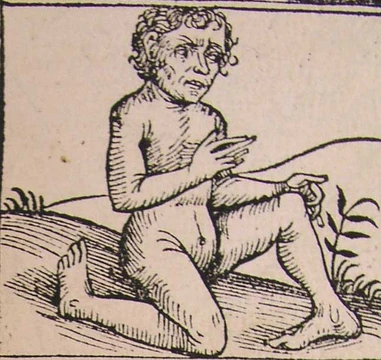
Back-footed being
Legendary beings with backwards feet appear in folklore worldwide.

Wikipedia / Wikimedia Commons
A back-footed being is a type of legendary creature whose feet or legs point backward, with variations from a clubfoot to a completely reversed orientation. This folkloric motif is widespread across global traditions, particularly in Latin American folklore, and most often appears as a mythic humanoid.
These beings are found in folklore throughout the Americas and Afro-Eurasia. Some sources have claimed that the ancient Greek historian Megasthenes described back-footed beings in India during the 4th century BCE, but no canonical record supports this attribution. The Motif-Index of Folk-Literature classifies this motif to include backwards feet, backwards toes, and creatures that can temporarily reverse their legs and feet. Some stories of back-footed beings, especially cryptids, may originate from misidentified animal tracks.
In the late 19th century, French folklore scholar Henri Gaidoz published a series of articles in the journal *Mélusine* noting the global prevalence of back-footed beings. He argued that the motif reflects a basic human belief that physical disabilities are malevolent, explaining why many such creatures are antagonistic in their tales. In 1905, A.T. Crawford Cree rejected this view, pointing to figures like Cú Chulainn, Hephaestus, and Leabharcham—though none of these are canonically described with backwards feet. Cree instead proposed that back-footed beings derive from theriomorphism—humanoid gods with animal traits—especially from avian humanoid (ornithomorphic spirit) legends; he suggested that backwards legs evoke bird-like qualities in a "less violent combination" than winged humanoids.
Cultural anthropologist Ramón Sarró wrote in 2008 that back-footed beings suggest the digitigrade legs of animals while retaining human features, making them distinct from both humans and animals. In 2015, Slovenian folklorist Monika Kropej identified them as an example of "backwards" fairy-like creatures from the Otherworld, comparable to other folkloric beings with reversed body features. Slovenian folklorist Barbara Ivančič Kutin stated in *Folklore* in 2018 that "Depictions of creatures with backward-pointing feet can, given the fact that they extend across many different parts of the world, essentially be regarded as archetypal."
A list of back-footed beings follows.
- category
- Legendary creature
- prevalence
- Americas and Afro-Eurasia
- earliest_recorded
- Often attributed to 4th century BCE India via Megasthenes, though no canonical record confirms this
- folkloric_motif
- Backwards feet, backwards toes, or temporarily reversible legs
- key_scholars
- Henri Gaidoz, A.T. Crawford Cree, Ramón Sarró, Monika Kropej, Barbara Ivančič Kutin
Lore & Background
Back-footed beings are a widespread folkloric motif. Some sources have claimed that the ancient Greek historian Megasthenes described such beings in India in the 4th century BCE, but no canonical record supports this. The motif, as identified in the Motif-Index of Folk-Literature, includes backwards feet, backwards toes, and beings that can temporarily reverse their legs and feet. The origin of such stories, particularly cryptids, may come from mis-identification of animal tracks.
Reader's Guide
French folklore scholar Henri Gaidoz in the late 19th century noted the global preponderance of back-footed beings, framing them as expressions of a base human belief that physical disabilities were malevolent, hence many are antagonistic. A.T. Crawford Cree in 1905 rejected this, pointing to benevolent examples like Cú Chulainn, Hephaestus, and Leabharcham, and instead conjectured that back-footed beings stem from theriomorphism—humanoid gods with animal features—especially avian humanoid legends, where backwards legs evoke avian qualities. Cultural anthropologist Ramón Sarró in 2008 argued that back-footed beings evoke digitigrade animal legs while retaining human qualities, making them distinct from both. Slovenian folklorist Monika Kropej in 2015 identified them as an example of 'backwards' fairy-like creatures of the Otherworld, comparable to other beings with backwards body features. Barbara Ivančič Kutin in 2018 wrote that depictions of creatures with backward-pointing feet, given their global extent, can be regarded as archetypal.
Did You Know?
- Some sources have claimed that ancient Greek historian Megasthenes wrote of back-footed beings in India in the 4th century BCE, but no canonical record confirms this.
- Henri Gaidoz framed back-footedness as an expression of a belief that physical disabilities were malevolent.
- A.T. Crawford Cree cited Cú Chulainn, Hephaestus, and Leabharcham as supposed benevolent examples, but none are canonically described with backwards feet.
Frequently Asked Questions
What is a back-footed being?
A back-footed being is a mythic humanoid creature found in world folklore whose legs or feet point in the opposite direction from a normal orientation. The motif covers a spectrum of physical traits, ranging from a mild clubfoot to fully reversed limbs, and it recurs as a recurring character type across many cultural traditions.
Where do back-footed beings appear in folklore?
These creatures show up in stories from the Americas and across Afro-Eurasia, with especially rich traditions in Latin American folklore. They are not confined to a single region but represent a broad cross-cultural folkloric theme.
What is the oldest known reference to a back-footed being?
The earliest surviving written account comes from the Greek historian Megasthenes, who described a group called the Nuli in India during the 4th century BCE. This places the motif in the literary record well before medieval European folklore collections.
What variations exist within the back-footed being motif?
Folklore scholars recognize several sub-types, including creatures with reversed feet, reversed toes, and even legs that can temporarily flip their orientation. The Motif-Index of Folk-Literature catalogs all of these as related entries under the broader backwards-footing category.
Who are the main scholars associated with studying back-footed beings?
Researchers such as Henri Gaidoz, A.T. Crawford Cree, Ramón Sarró, Monika Kropej, and Barbara Ivančič Kutin have each contributed significant work on the motif's distribution and interpretation. Their studies span comparative mythology, ethnography, and folk-literature classification.
More in Back-footed beings 1-23
Spotted an error? Know more?
This is a living reference — every entry is fact-audited, and reader corrections feed straight into our audit queue. Suggest an edit · See this site's audit record