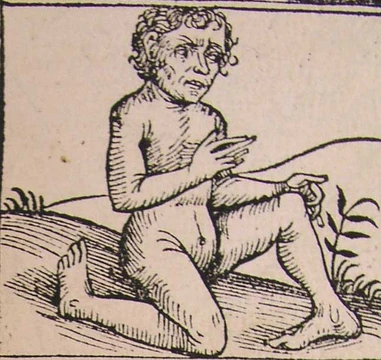
Douen
A faceless, backwards-footed entity that lures children into the woods.

Wikipedia / Wikimedia Commons
The Douen (or Dwen, in Saint Lucian folklore) is a figure from Trinidadian and Saint Lucian stories. Its most notable trait is having backwards feet—heels pointing forward—along with backwards knees and a lack of facial features. To conceal its blank face, it wears a large, floppy straw hat, leaving only a small mouth for speaking. This entity is mostly mischievous, pulling pranks, stealing from gardens, and taking particular delight in calling children by name using a parent’s voice to lure them deep into the woods until they are hopelessly lost.
The folklore has African roots, blended with French, Spanish, and English influences. African religious and semi-religious cults have heavily shaped the island’s traditions, and many supernatural characters mirror African deities. It is difficult to separate strict religious elements from what are considered customs. In the African tradition, these stories were used to teach children values. Based on descriptions of the Douen and Dwen, the folklore may have originated from the Mayan Tata Duende or the Latin-American duende.
In popular culture, Douen appear prominently in “Lost and Found,” a season 4 episode of the Syfy series *Haven*. They are mentioned twelve times in Kareem Abdul-Jabbar and Anna Waterhouse’s novel *Mycroft Holmes*. In Nalo Hopkinson’s novel *Midnight Robber*, “douen” describes a sentient species on another planet; human characters explain that on foreign worlds, the term is used to frighten children, suggesting these creatures are dead children risen from the grave.
- field
- Folklore
- nationality
- Trinidadian / Saint Lucian
- known_for
- Backwards feet and knees, faceless appearance, luring children into the forest
Lore & Background
The Douen is a mischievous entity in Trinidadian and Saint Lucian folklore. Its most notable physical traits are its backwards feet and knees, and its lack of a face, which it hides under a large floppy straw hat, leaving only a small mouth visible. It is known to play pranks on people, raid gardens, and especially enjoys leading children astray until they become thoroughly lost in the forest. If a Douen hears a child's name, it can call to the child using a parent's voice to lure them into the woods.
The folklore of the Douen is primarily of African foundation, with French, Spanish, and English influences. Religious or semi-religious cults of African origin have contributed much to the island's folklore, and many supernatural folklore characters are identical with those of African deities. It is exceedingly complicated to draw a line between the stern religious elements and what may be described as traditions. In the African tradition, stories were meant to instill values in children.
Based on the description of the Trinidadian Douen and Saint Lucian Dwen, it seems that this folklore may have originated from the Mayan folklore Tata Duende or the Latin-American folklore of duende.
Reader's Guide
The Douen holds significance as a cautionary figure in Trinidadian and Saint Lucian folklore, primarily used to instill values in children by warning them against wandering into the forest or speaking to strangers. Its distinctive backwards feet and faceless appearance make it a memorable and eerie entity, while its ability to mimic a parent's voice underscores the danger of deception. The folklore's African foundation, blended with French, Spanish, and English influences, reflects the complex cultural history of the Caribbean. The possible connection to Mayan Tata Duende or Latin-American duende suggests a broader regional folkloric tradition. In popular culture, the Douen has appeared in television (Haven), literature (Mycroft Holmes by Kareem Abdul-Jabbar and Anna Waterhouse), and science fiction (Midnight Robber by Nalo Hopkinson), where it is described as a sentient species on another planet and used as a threat to frighten children. This legacy demonstrates how folklore adapts to new contexts while retaining its core function as a moral and cautionary tale.
Did You Know?
- The Douen's feet and knees are backwards, with the heel facing the front.
- They wear a big, floppy straw hat to hide their faceless appearance, except for a small mouth.
- If a Douen hears a child's name, it can call to the child in a parent's voice to lure them into the forest.
- The folklore may have originated from Mayan Tata Duende or Latin-American duende.
Frequently Asked Questions
Who is Douen?
Douen is a mischievous, faceless spirit from Trinidadian and Saint Lucian folklore, also called Dwen in Saint Lucia. It is one of the most recognizable back-footed beings in Caribbean storytelling.
What does Douen look like?
This entity has its heels and knees pointing backward, and its face is completely blank except for a small mouth it uses to speak. To hide its featureless face, it wears an oversized, floppy straw hat.
What does Douen do?
Douen is known for pulling pranks, raiding gardens, and most disturbingly, mimicking a parent's voice to call children by name and lead them deep into the woods until they are lost.
Where does Douen come from?
The Douen legend has African roots and was carried into the Caribbean, where it became a staple of Trinidadian and Saint Lucian oral traditions. It exists as a folk figure rather than a character in a single written story.
Why is Douen important in Caribbean folklore?
The Douen serves as a cautionary figure warning children to stay close to home and not follow unfamiliar voices in the forest. Its backwards feet and faceless design make it one of the most visually distinctive creatures in Caribbean folklore.
More in Back-footed beings 1-23
Spotted an error? Know more?
This is a living reference — every entry is fact-audited, and reader corrections feed straight into our audit queue. Suggest an edit · See this site's audit record